Supporting Service-Connected Learners in Teacher Education: An Interview with David Mather
Posted in Views by Victoria Fisher
As part of our ongoing focus on strengthening provision for Service children across the education system, we spoke with David Mather, Senior Lecturer in Education and Leadership. David’s work explores identity, belonging and transition, particularly for Armed Forces–connected and blue-light communities. Through teaching, research and civic engagement, he advocates for educational environments that recognise learners’ prior experience and foster meaningful belonging. He is also the founder of We See You, a civic conversation on how Portsmouth can support Armed Forces, veteran and blue-light learners to feel seen, understood and able to thrive.
How do you support trainee teachers to understand the lived experiences of service children?
Supporting trainee teachers to understand the lived experiences of service children begins with a commitment to belonging rather than deficit. Service children are frequently discussed in relation to mobility, disruption or attainment gaps. While these factors may be present, they do not define the child. My approach in based in recognising the significance of identity, relational safety and recognition.
I encourage ITE trainees to move beyond surface awareness and engage critically with the structural and cultural contexts that shape service children’s experiences. This includes exploring the impact of parental deployment, frequent school moves, separation and uncertainty. It also involves recognising the strengths that many service children develop, including adaptability and cultural awareness.
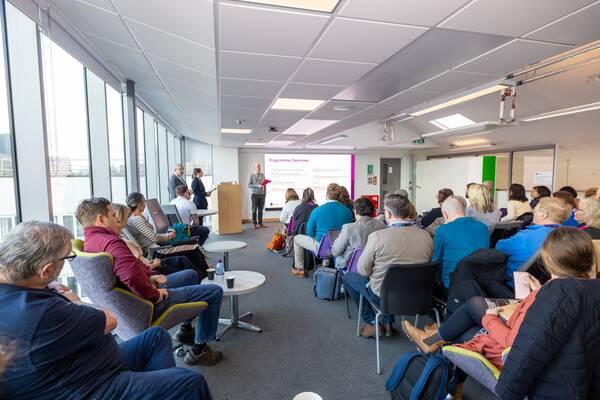
Through We See You, this work is framed within a civic commitment. Service-connected learners are part of our local and national communities. I position teacher education as a space where civic responsibility and professional identity intersect. Trainees are asked to consider not only how to support individual pupils, but how education institutions can operate as anchor organisations that promote continuity, recognition and stability.
How have you embedded the Thriving Lives Toolkit within your teacher training curriculum, and why did you choose to use it as a framing resource rather than an add-on?
“The Toolkit moved the conversation from goodwill to intentional design.”
The Thriving Lives Toolkit acted as the catalyst for the Initial Teacher Education connected strand of We See You. While We See You addresses Armed Forces, veteran and blue light communities more broadly, the Toolkit provided a structured and research informed framework that enabled us to focus specifically on service children within teacher education.
Its significance lies in its design. The Toolkit does not present service children as a problem to be managed. It offers a developmental and reflective framework that invites institutions to consider culture, policy, practice and partnership. For that reason, it became a framing resource rather than an add on. It strengthened the ITE dimension of We See You by grounding it in a framework and moving the conversation from goodwill to intentional design.
Can you share an example of how the Toolkit has influenced a learning activity, reflective discussion or professional conversation within your ITE programme?
“The Toolkit’s principles enabled trainees to think beyond individual circumstance and towards systemic response.”
In a recent session with our PGCE Further Education and Skills cohort, I structured the learning around the seven principles of effective support outlined in the Toolkit. The discussion was deliberately situated within post 16 contexts, where many learners are navigating multiple and overlapping challenges, including questions of identity, belonging and future direction.
Further education settings often serve young people and adults balancing vocational choice, financial pressure and family responsibility. For service-connected learners, these pressures may intersect with mobility, deployment and separation. The Toolkit’s principles enabled trainees to think beyond individual circumstance and towards systemic response. We explored clarity of approach, effective transition, wellbeing, achievement, partnership and staff awareness within a post 16 setting.
What changes have you observed in trainees’ perspectives or classroom practice as a result of understanding the lived experiences of service children and engaging with the Toolkit?
The most significant change has been at the level of mindset. Engagement with the Toolkit has encouraged trainees to see inclusion as relational and contextual rather than as a set of isolated strategies.
It has also created space for disclosure. In more than one session, trainees who had not previously identified themselves as forces connected chose to share aspects of their own experiences. In those moments, lived experience became a source of knowledge for peers. The discussion shifted from abstraction to immediacy, deepening understanding across the cohort. The Toolkit, by framing discussion around principles rather than deficits, enabled these conversations to take place within a respectful and structured environment.
Thinking about the We See You Civic Networking Event, what key reflections or insights emerged from delegates regarding how education systems can better support service connected learners across the life course?
The event reinforced the importance of civic partnership and the role of education institutions as anchor organisations. Delegates from schools, colleges, universities and third sector organisations recognised that support for service-connected learners cannot sit within a single phase. Transitions across the life course remain points of vulnerability, and continuity requires shared language and coordinated action.
There was strong recognition that visibility must be embedded within culture and policy, not confined to statements of intent. Supporting service connected learners is shaped by place, partnership and sustained institutional commitment rather than isolated intervention.
What emerging outcomes or lessons would you highlight for other ITE providers seeking to embed the Thriving Lives Toolkit meaningfully?
The most important lesson is to give it time. The Toolkit is not a compliance exercise. It addresses a group of children and young people who have not historically been seen in systematic ways within education. Meaningful embedding requires space for dialogue, institutional reflection and cultural alignment.
When treated as a whole institution framework rather than a discrete initiative, it enables sustainable change. For ITE providers, the message is: Do not treat the Toolkit as an enhancement. Treat it as an opportunity to make visible a group of learners who have too often navigated education without recognition.